Nuevas pedagogías para la educación multilingüe
DOI:
https://doi.org/10.5294/laclil.2019.12.1.1Resumen
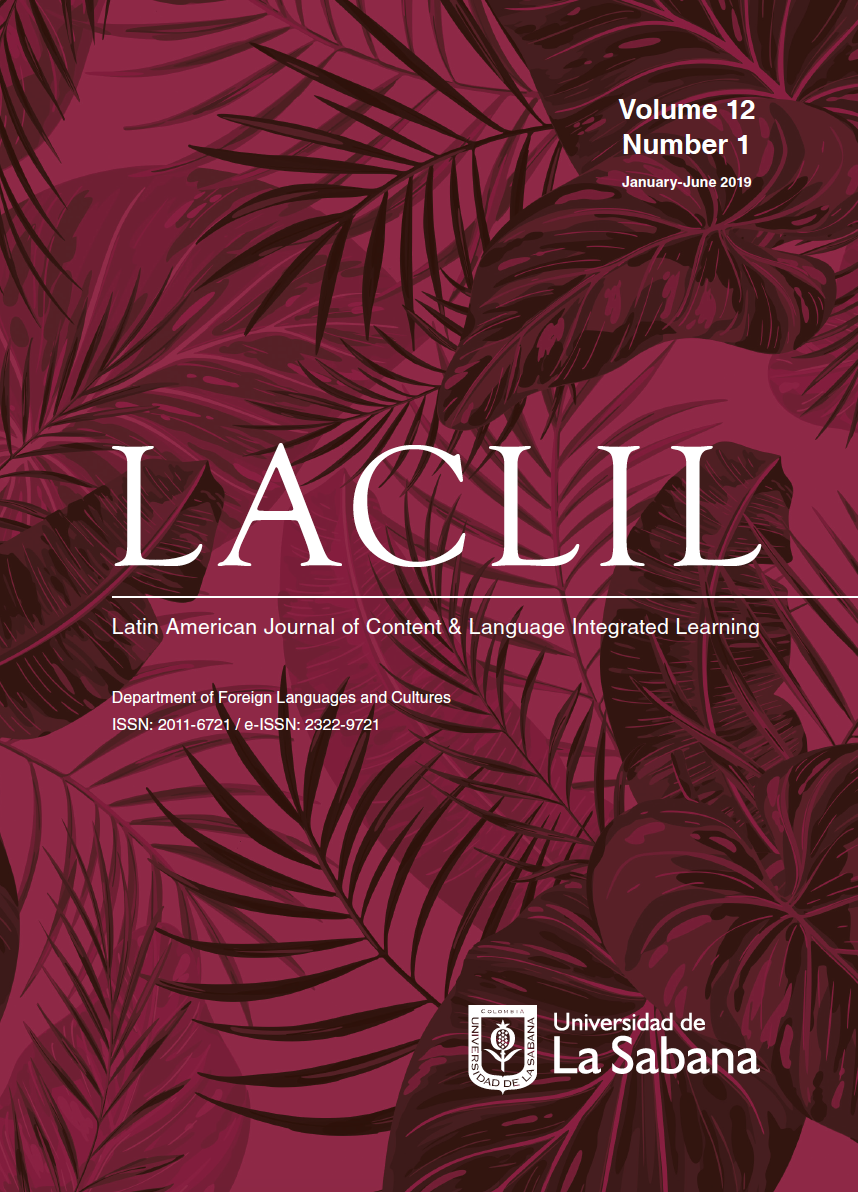
To reference this article (APA) / Para citar este artículo (APA) / Para citar este artigo (APA)
McDougald, J. (2019). New pedagogies for multilingual education. LACLIL, 12(1), 9-17. DOI: https://doi.org/10.5294/laclil.2019.12.1.1
Descargas
Citas
Abentao, D. R., Castillo, M. C., Atitiw, J. G., & Asuncion, M. P. (2018). ESL teaching challenges in the 21st century in a multicultural context. Sydney, Australia: Amazon Australia Services, Inc.
Banegas, D. L. (2012). CLIL teacher development: Challenges and experiences. Latin American Journal of Content and Language Integrated Learning, 5(1), 46–56. http://dx.doi.org/10.5294/laclil.2012.5.1.4
de Mejía, A.-M. (2011). The national bilingual programme in Colombia: Imposition or opportunity? Apples – Journal of Applied Language Studies, 5(3), 7–17. Retrieved from https://jyx.jyu.fi/dspace/handle/123456789/37104
Edwards, R., Holguín-Barrera, M. D., Ortiz, A. C., & Pérez, F. (2019). Promoting EFL learner autonomy in a teacher-centered culture through video-sharing and collaborating in online forums. Latin American Journal of Content & Language Integrated Learning, 12(1), 99-127. https://doi.org/10.5294/laclil.2019.12.1.5
Fandiño-Parra, Y. J., Bermúdez-Jiménez, J. R., & Lugo-Vásquez, V. E. (2012). The challenges facing the National Program for Bilingualism. Bilingual Colombia. Educación y Educadores, 15(3), 363–381. http://dx.doi.org/10.5294/edu.2012.15.3.2
García, O., & Wei, L. (2014). Translanguaging: Language, Bilingualism and Education. London, UK: Palgrave Macmillan UK. http://dx.doi.org/10.1057/9781137385765
Garton, S., Copland, F., & Burns, A. (2013). Investigating global practices in teaching English to Young Learners. British Council ELT Research Papers Volume 1, 35–68.
Granados, J. (2018). The challenges of higher education in the 21st century. Global University Network of Innovation. Retrieved from http://www.guninetwork.org/articles/challenges-higher-education-21st-century
Humphries, S., & Burns, A. (2015). “In reality it’s almost impossible”: CLT-oriented curriculum change. ELT Journal, 69(3), 239–248. http://dx.doi.org/10.1093/elt/ccu081
Jaramillo, S., Opina, D. A., & Reinoso, P. E. (2016). Analysis of a dynamic bilingual education model based on CLIL and translanguaging in a state school (Published Undergraduate Thesis, Licenciatura en Lengua Inglesa). Pereira: Universidad Tecnológica de Pereira.
Kashiwagi, K., & Tomecsek, J. (2015). How CLIL classes exert a positive influence on teaching style in student centered language learning through overseas teacher training in Sweden and Finland. Procedia - Social and Behavioral Sciences, 173, 79–84. http://dx.doi.org/10.1016/j.sbspro.2015.02.034
Lasagabaster, D., & García, O. (2014). Translanguaging: hacia un modelo dinámico de bilingüismo en la escuela. Cultura y Educación, 26(3), 557–572. http://dx.doi.org/10.1080/11356405.2014.973671
Marsh, D. (2002). CLIL/EMILE - The European dimension: Actions, trends and foresight potential. Retrieved from https://jyx.jyu.fi/bitstream/handle/123456789/47616/david_marsh-report.pdf?sequence=1&isAllowed=y
Maurais, J. (2009). Towards a new global linguistic order? In J. Maurais & M. A. Morris (Eds.), Languages in a globalising World (pp. 13–36). Cambridge, England: Cambridge University Press. http://dx.doi.org/10.1017/CBO9780511613739.002
McDougald, J. S. (2018). Perspectiva moderna para la didáctica del bilingüismo. Revista Internacional Magisterio Educacion & Pedagogía, 94, 60–62.
Moayeri, M., & Rahimiy, R. (2019). The significance of promoting teacher reflection: A review article. Latin American Journal of Content & Language Integrated Learning, 12(1), 128-143. https://doi.org/10.9452/laclil.2019.12.1.6
Parab, V. (2015). Innovative techniques, methods & trends in English language teaching. IOSR Journal of Humanities and Social Science (IOSR-JHSS), 20(6), 40–44. http://dx.doi.org/10.9790/0837-20614044
Pat-López, M. A., & Sánchez-Escobedo, P. A. (2019). The role of English language for high-achieving Mayan students in the Yucatan Region, Mexico. Latin American Journal of Content & Language Integrated Learning, 12(1), 46-71. https://doi.org/10.5294/laclil.2019.12.1.3
Pavón-Vázquez, V., & Cabezuelo, R. (2019). Analyzing mathematical word problem solving with secondary education CLIL students: A pilot study. Latin American Journal of Content & Language Integrated Learning, 12(1), 18-45. https://doi.org/10.5294/laclil.2019.12.1.2
Penprase, B. E. (2018). The fourth industrial revolution and higher education. In N. Gleason (Ed.), Higher education in the era of the fourth industrial revolution (pp. 207–228). Singapore, Republic of Singapore: Palgrave Macmillan. http://dx.doi.org/10.1007/978-981-13-0194-0_9
Pogrow, S. (2005). HOTS revisited: A thinking development approach to reducing the learning gap after grade 3. Phi Delta Kappan, 87(1), 64–75. http://dx.doi.org/10.1177/003172170508700111
Sánchez, L. F., & López-Pinzón, M. M. (2019). The effect of the Process-Based Approach on the writing skill of elementary bilingual students. Latin American Journal of Content & Language Integrated Learning, 12(1), 72-98. https://doi.org/10.5294/laclil.2019.12.1.4
Scott, C. L. (2015). The futures of learning 3: What kind of pedagogies for the 21st century? (Education Research and Foresight Working Papers No. 15). Paris, France: UNESCO. Retrieved from https://unesdoc.unesco.org/ark:/48223/pf0000243126
Vega, M. V., & Moscoso, M. de L. (2019). Challenges in the implementation of CLIL in higher education: From ESP to CLIL in the tourism classroom. Latin American Journal of Content & Language Integrated Learning, 12(1), 144-176. https://doi.org/10.9452/laclil.2019.12.1.7

Descargas
Publicado
Cómo citar
Número
Sección
Licencia
Los autores que publican en esta revista están de acuerdo con los siguientes términos:
Esta revista y sus artículos se publican bajo la licencia Creative Commons Atribución-NoComercial-SinDerivadas 4.0 Internacional (CC BY-NC-ND 4.0), por lo cual el usuario es libre de: compartir, copiar y redistribuir el material en cualquier medio o formato, siempre y cuando: dé crédito de manera adecuada, brinde un enlace a la licencia e indique si se han realizado cambios; no use nuestro contenido con propósitos comerciales; y/o remezcle o transforme el material. Recuerde que no tiene los permisos para distribuir el material si fue modificado.